Are Synthetic Lawn Pesticides Facing More Restrictions? What New Jersey Families Should Know
States are paying more attention to the effects some lawn and landscape insecticides can have on pollinators, aquatic organisms and the wider environment. That does not mean every conventional pesticide is about to be banned. It does mean homeowners have more reason than ever to understand exactly what is being applied around their homes — and why.

Quick Guide — tap to open
The Quick Answer: Pesticide Rules Are Evolving, but the Story Is More Complicated Than “Everything Is Being Banned”
In recent years, states and municipalities have increased restrictions on certain pesticide uses, particularly where lawmakers are concerned about pollinators, public spaces, water quality and unnecessary cosmetic applications.
The Weekly Bite
Get 5 fresh yard-defense reads every Wednesday
Tick and mosquito intel for North Jersey yards. No spam, unsubscribe anytime.
Some restrictions have focused on specific chemical classes, such as certain neonicotinoid insecticides. Others regulate who can apply particular products, where they may be applied or how pesticides may be used on public property.
That is different from saying synthetic tick and mosquito pesticides are universally banned or about to disappear.
The more useful takeaway for a homeowner is this: pesticide choice matters, application method matters and the amount of chemical exposure created by a pest-control program matters.
Why Are States Looking More Closely at Lawn and Landscape Pesticides?
Modern insecticides can be highly effective. That effectiveness is exactly why regulators and researchers pay attention to what happens when biologically active chemicals leave the pest, plant or surface they were intended to reach.
Some insecticides can affect bees and other beneficial insects, particularly when residues occur on blooming plants or when exposure happens during foraging.
Certain insecticides are highly toxic to fish or aquatic invertebrates, making runoff, storm drains and water adjacency important parts of responsible application.
Schools, parks, playgrounds and other public areas often receive extra regulatory attention because so many people use them.
Different pesticides behave differently in soil, on foliage, in sediment and in sunlight. Regulators consider these differences when assessing risk.
“Pesticide” Is a Huge Category — and Not All Products Behave the Same Way
It is easy to talk about pesticides as though every product carries the same risk.
They do not.
A synthetic pyrethroid used as a residual barrier spray has a different chemistry, environmental behavior and toxicology profile than an essential-oil minimum-risk product.
Even within the same chemical class, individual active ingredients can vary in persistence, aquatic toxicity, formulation and label restrictions.
That is why homeowners should look past words like “professional,” “natural,” “green” or “family friendly” and ask a much simpler question:
What are the actual active ingredients being applied?
Synthetic Pyrethroids: Effective Insecticides With Real Tradeoffs
Synthetic pyrethroids are among the most common insecticides used in residential mosquito and tick control.
These compounds act on voltage-gated sodium channels in insect nerve cells. They keep those channels functioning abnormally, interfering with normal nerve signaling and ultimately causing paralysis and death in susceptible insects.
That broad insecticidal activity is one reason they work so well. It is also one reason application technique matters.
A broad-spectrum insecticide can affect non-target arthropods that contact a treated surface.
Many pyrethroids are highly toxic to aquatic organisms, especially fish and aquatic invertebrates.
Residual barrier treatments are intended to remain active on treated surfaces long enough to affect insects that contact them.
Applying any insecticide indiscriminately across flowering vegetation or unnecessary open lawn creates exposure without necessarily improving control.
None of this means that every label-compliant pyrethroid treatment is inherently unsafe. It means these are powerful biologically active products with tradeoffs worth understanding.
Why Neonicotinoids Have Received So Much Regulatory Attention
Neonicotinoids are a different insecticide class. They act on nicotinic acetylcholine receptors in the insect nervous system.
Several neonicotinoids are systemic, meaning the active ingredient can move through plant tissue rather than remaining only where it was deposited.
That feature can be useful when protecting a plant from damaging insects, but it has also created concern when pollinators may be exposed through contaminated pollen or nectar.
As a result, several states have moved certain neonicotinoid products away from unrestricted homeowner use or imposed additional limitations.
Restrictions on neonicotinoids do not automatically mean the same rule applies to synthetic pyrethroids used in a mosquito barrier treatment. Chemical class and legal use matter.
What Happens Near Storm Drains, Ponds and Water Is Just as Important as What Happens on the Lawn
One of the biggest differences between a carefully planned application and careless spraying is what happens at the edge of the treatment area.
Insecticides can reach water through direct application, overspray, runoff or movement of contaminated soil and sediment.
This is especially important with active ingredients that are highly toxic to aquatic invertebrates or fish.
I'm a mom first, so when we started Bite Back one of my biggest questions was really simple: what are we actually putting around people's homes? I wanted something different from the traditional synthetic yard-spray model. That does not mean every conventional pesticide is automatically bad. It means I wanted our company to start with a lower-risk approach and be very intentional about where we apply it.
What Does “EPA Section 25(b) Exempt” Actually Mean?
Bite Back uses products built around active and inert ingredients that qualify for the EPA's minimum-risk pesticide exemption under Section 25(b) of the Federal Insecticide, Fungicide, and Rodenticide Act.
That does not mean the ingredients have no biological effect. They are pesticides because they are used to repel, control or kill pests.
The exemption applies when a product meets the federal requirements for qualifying active ingredients, inert ingredients and labeling.
The product is formulated from ingredients that meet EPA's minimum-risk exemption criteria.
It is not a government guarantee that unlimited exposure is harmless or that every ingredient is safe for every organism at every concentration.
We think that distinction matters. “Natural” should never be used as an excuse to stop thinking about dose, placement, flowering plants, pets or water.
Conventional Residual Yard Treatment vs. Bite Back's Approach
There is no honest one-line comparison that applies to every pesticide company. Products and application practices vary.
But the basic philosophy is different.
Often uses synthetic pyrethroids selected for residual insecticidal activity on vegetation and perimeter surfaces.
Uses an essential-oil/minimum-risk approach rather than synthetic pyrethroids for the normal seasonal yard program.
Some programs heavily rely on broad barrier treatment over substantial sections of vegetation.
Focuses on shaded landscaping, wood lines, fence lines, brush edges, foundation plantings, under decks and other pest habitat rather than unnecessary open lawn.
May increase spray intensity or expand residual treatment.
Adds premium granular treatment at intervals to strengthen tick protection in higher-pressure yards.
Environmental precautions vary by active ingredient, formulation and label.
Begins with a minimum-risk formulation and combines that choice with targeted application and habitat management.
The Product Is Only Half the Story — Where It Is Applied Matters Too
One of the biggest lessons we have learned after tens of thousands of yard applications is that more spray is not automatically better pest control.
Ticks and mosquitoes are not distributed evenly across a property.
Wood lines, leaf litter, brush, fence lines, dense groundcover and shaded transition zones are far more important than the center of a sunny lawn.
Dense shrubs, shaded landscaping, under-deck areas and humid protected vegetation often matter more than exposed grass.
Blooming plants may be actively visited by bees and other pollinators, so they should not be treated casually.
Ponds, drainage routes and water-sensitive areas deserve intentional avoidance and label-conscious application.
Why Bite Back Uses Granular Protection in Higher-Pressure Tick Yards
Some properties simply create more tick pressure than others.
Wooded borders, heavy leaf litter, wildlife traffic, unfenced properties and dense groundcover can all create conditions where a standard seasonal spray program may benefit from another layer of protection.
That is where Shield Plus comes in.
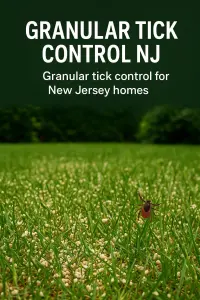
Shield Plus adds our premium granular treatment at intervals during the season. The granules allow us to supplement the normal targeted spray program at ground level in areas where ticks spend significant portions of their life cycle.
Five Questions to Ask Any Tick or Mosquito Company Before They Treat Your Yard
Ask for the actual chemical or botanical names — not just “green,” “natural” or “professional grade.”
A technician should be able to explain which habitats are being targeted and why.
Flowering plants, vegetable gardens, ponds and other sensitive areas deserve a thoughtful answer.
Good pest management should have a strategy beyond simply “spray more.”
Reputable companies should be transparent about what they use.
Why Bite Back Chose a Different Starting Point
Bite Back did not start because we believed pest control was unnecessary.
It started because we wanted effective tick and mosquito control without making conventional synthetic residual insecticides the default answer around the places families spend time.

Natural Does Not Mean “Risk-Free” — and We Don't Think Companies Should Pretend It Does
Essential oils are biologically active compounds.
They can repel or kill insects precisely because they affect biological systems. Concentration, route of exposure, formulation, species and application location still matter.
So our position is not that every synthetic product is poison and every natural product is harmless.
Our position is that families deserve to know what is being applied and should be able to choose a pest-control strategy that starts with a more favorable risk profile when an effective alternative is available.
Want Tick and Mosquito Protection Without a Traditional Synthetic Yard-Spray Program?
Bite Back provides targeted all-natural tick and mosquito control across New Jersey using an essential-oil/minimum-risk approach.
We focus on the places pests actually use rather than treating every inch of the property simply because we can.
Choose Bite Back, because what is sprayed in your yard matters. 🌿
Trusted Resources & Further Reading
Pesticide regulations and product registrations change over time. For current rules and ingredient information, use primary government and university sources.
- U.S. EPA — Minimum Risk Pesticides Exempted Under FIFRA Section 25(b)
- U.S. EPA — Pollinator Protection
- U.S. EPA — Pyrethrins and Pyrethroids
- U.S. EPA — Pollinators and Pesticide Risk
- New Jersey Department of Environmental Protection — Pesticide Control Program
- Bite Back — Natural Granular Tick Control
- Bite Back — Yard Maintenance and Tick Prevention
Frequently Asked Questions
Are synthetic mosquito and tick pesticides being banned?
There is no single nationwide ban on conventional mosquito and tick pesticides. Some states and municipalities have restricted particular active ingredients, product categories or uses, especially in areas involving pollinators, public spaces or cosmetic lawn treatment. Rules vary by jurisdiction and product.
Are synthetic pyrethroids the same as neonicotinoids?
No. They are different insecticide classes with different modes of action and environmental characteristics. Pyrethroids act primarily on voltage-gated sodium channels. Neonicotinoids act on nicotinic acetylcholine receptors.
Does “EPA 25(b) exempt” mean EPA-approved?
Not in the same way as a conventionally registered pesticide. Section 25(b) establishes a federal exemption for qualifying minimum-risk pesticide products that meet specified ingredient and labeling requirements.
Does “natural” mean completely safe?
No. Natural ingredients can still be biologically active. Concentration, formulation, route of exposure and application location matter. Bite Back's preference for minimum-risk ingredients does not mean we believe any pesticide should be used carelessly.
Does Bite Back use synthetic pyrethroids?
Bite Back's normal seasonal tick and mosquito program is built around an all-natural essential-oil/minimum-risk approach rather than synthetic pyrethroids.
Does an all-natural treatment still control ticks and mosquitoes?
Pest reduction depends on much more than the ingredient alone. Bite Back combines targeted treatments with inspection, habitat knowledge, seasonal consistency and additional granular protection for higher-pressure tick properties.
Why doesn't Bite Back spray the entire lawn?
Ticks and mosquitoes tend to concentrate in particular habitats, including shaded landscaping, wooded transitions, brush, fence lines and protected vegetation. Targeting those areas can reduce unnecessary treatment of low-value zones such as open sunny lawn.
What is Shield Plus?
Shield Plus is Bite Back's enhanced program for properties that benefit from additional tick protection. It combines the normal seasonal treatment with premium granular applications at intervals during the season.
Should I ask my pest-control company what product they use?
Yes. Homeowners should know the active ingredients being applied, where they are being used and what label precautions apply. A reputable company should be able to provide that information.
Will pesticide regulations continue to change?
They can. Product registrations, state restrictions and pesticide rules evolve as new scientific and policy information becomes available. EPA, NJDEP and other relevant government agencies are the best sources for current legal requirements.
Final Takeaway: The Better Question Isn't “Is It Legal?” — It's “Is This the Approach I Want Around My Home?”
Pesticide regulations set the legal boundaries for how products may be sold and used.
Homeowners can still make a more personal choice within those boundaries.
You can ask what is being sprayed. You can ask where it is being applied. You can ask what happens near flowering plants and water. And you can decide whether a broad-spectrum synthetic residual program is the approach you want for your own property.
Bite Back chose a different starting point: minimum-risk ingredients, targeted application, habitat management and layered protection when pressure is high.
The goal is not to use the strongest chemical available. The goal is to solve the pest problem responsibly.
This article is educational and is not legal or regulatory advice. Pesticide registrations, labels and state regulations can change. Always follow the current product label and applicable federal, state and local requirements.
The Weekly Bite
Get 5 fresh yard-defense reads every Wednesday
Tick and mosquito intel for North Jersey yards. No spam, unsubscribe anytime.