What Do Mosquito Larvae Look Like? How to Find ‘Wigglers’ in Your Yard
Those tiny organisms wriggling in a bucket or birdbath may be mosquito larvae. Learning to recognize the aquatic stages turns mosquito control from guesswork into something you can inspect with your own eyes.

The Weekly Bite
Get 5 fresh yard-defense reads every Wednesday
Tick and mosquito intel for North Jersey yards. No spam, unsubscribe anytime.
Quick Guide: tap to open
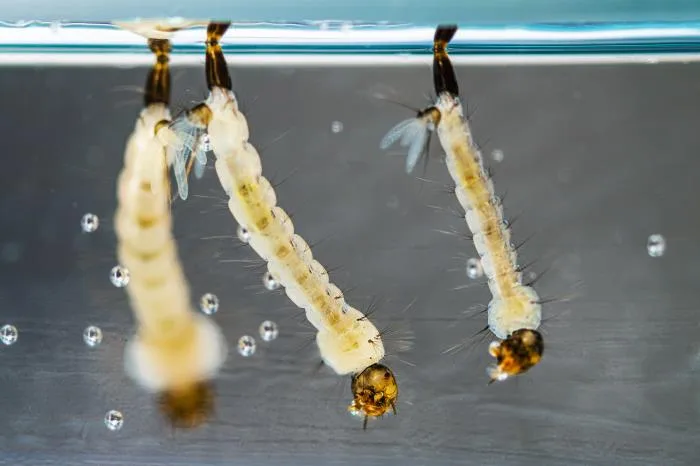
The Quick Answer: Larvae Are the Wriggling Aquatic Stage
All mosquitoes develop through egg, larva, pupa and adult stages. Larvae live in water and are often called wigglers because of their jerky swimming motion.
They are narrow, segmented and usually hang or move near the water surface before diving when disturbed. Pupae are shorter and more comma-shaped; they are often called tumblers because they flip through the water.
Seeing larvae is direct proof that the container is producing mosquitoes unless the water is removed or treated appropriately.
Larva vs. Pupa vs. Other Tiny Water Life
Not every moving speck in water is a mosquito. A close look at shape and movement helps.
Longer, slender body with a distinct head and wriggling motion. Often returns to the surface to breathe.
More compact, curved/comma-shaped body. Tumbles rapidly when disturbed and does not feed.
Emerges from the pupal skin at the surface and leaves the water as a flying insect.
Midges, aquatic insects and small crustaceans can also occur in water. Identification matters before assuming every organism is a mosquito.
Where to Look for Larvae Around a New Jersey Home
Rutgers emphasizes that container-breeding mosquitoes can use very small water sources in developed areas.
Look anywhere water remains long enough for development, not only obvious puddles.
Asian Tiger Mosquito Larvae Can Develop in Very Small Containers
Rutgers describes the Asian tiger mosquito, Aedes albopictus, as an opportunistic container breeder able to use a wide range of natural and artificial water sources.
Historic New Jersey collections found larvae in tires, buckets, a drink cup, a crushed beverage can and even small holes in a discarded socket-set case after a brief shower.
That is why a property can have serious daytime mosquito pressure without a pond or marsh anywhere nearby.
What to Do When You Find Mosquito Larvae
If the water is unnecessary, the simplest intervention is usually to dump it where it will dry, then clean or scrub the container before it refills.
Scrubbing matters for Aedes containers because eggs can be attached to the inner walls just above the waterline and may survive dry periods until they are flooded again.
For water that cannot be dumped (such as certain ornamental or drainage features), use only a larvicide labeled for that site and follow all directions. BTI products are one option for appropriate standing-water habitats.
Remove unnecessary standing water rather than waiting for adults to emerge.
Clean container walls where Aedes eggs may be attached.
Turn containers over or cover them so they cannot refill.
For water that must remain, use a labeled larval-control product suitable for the site.
A clean yard can become full of breeding containers after one storm.
How Long Until Those Larvae Become Adults?
Temperature and species matter. CDC notes that Aedes mosquitoes can complete the egg-to-adult cycle in roughly 7–10 days under favorable conditions.
Rutgers notes that during hot summer weather, some mosquito larvae can grow rapidly, pupate and emerge as adults in about a week.
That is why weekly source reduction (and a quick check after major rain) has real biological value.
Why Larval Control and Adult Control Are Different Jobs
Dumping breeding water stops future production. It does not immediately remove adult mosquitoes already resting in shaded vegetation.
Likewise, treating adult resting habitat does not fix an overflowing birdbath or clogged gutter that keeps creating new mosquitoes.
Strong mosquito management addresses both sides of the life cycle.
I love showing homeowners mosquito larvae because once you see the little wigglers, standing water stops feeling theoretical. You can actually watch the next mosquito problem developing. Dumping that water is one of the simplest pest-control jobs a family can do itself.
Trusted Sources & Further Reading
The factual foundation for this guide includes the following public-health, university and peer-reviewed resources.
- CDC: Life Cycle of Aedes Mosquitoes: Egg-to-adult stages and typical 7–10 day development.
- Rutgers Center for Vector Biology: General Mosquito Biology: Aquatic larval/pupal stages and residential sources.
- Rutgers: Aedes albopictus: New Jersey container habitats and small-volume breeding.
- Rutgers: Larval Habitats of Mosquitoes: Examples of larval habitats by mosquito group.
Frequently Asked Questions
What do mosquito larvae look like?
They are small, elongated, segmented aquatic organisms that often wriggle near the water surface and dive when disturbed.
What are mosquito wigglers?
‘Wigglers’ is a common name for mosquito larvae because of their characteristic movement in water.
What are mosquito tumblers?
Tumblers are mosquito pupae. They are more compact and comma-shaped and move with a tumbling motion.
How fast do larvae become adult mosquitoes?
Development varies, but CDC says some Aedes mosquitoes can complete the egg-to-adult cycle in about 7–10 days under favorable conditions.
Does dumping the water kill mosquito larvae?
Removing water and allowing larvae to dry interrupts development. Clean the container too, because some Aedes eggs can remain stuck to the walls.
What if I cannot dump the water?
Use an appropriate larval-control product labeled for that type of water, or contact local mosquito control for larger or complex sources.
Stop the Next Mosquito Generation While It Is Still in the Water
Bite Back provides targeted, all-natural tick and mosquito control for New Jersey yards. Our service focuses on the shaded edges, landscaping, fence lines, wooded borders and other areas where pest pressure develops.
No yard can be made completely tick- or mosquito-free, but habitat reduction, smart prevention and consistent seasonal treatment can make a meaningful difference.
Choose Bite Back, because what is sprayed in your yard matters.
The Weekly Bite
Get 5 fresh yard-defense reads every Wednesday
Tick and mosquito intel for North Jersey yards. No spam, unsubscribe anytime.