What Does a Tick Nest Look Like? Tick Eggs, Larvae & the ‘Nest’ Myth
The phrase ‘tick nest’ is everywhere online, but ticks do not build organized nests. What people usually mean is an egg mass, a cluster of newly hatched larvae or simply an area with a lot of tick activity.

The Weekly Bite
Get 5 fresh yard-defense reads every Wednesday
Tick and mosquito intel for North Jersey yards. No spam, unsubscribe anytime.
Quick Guide: tap to open
The Quick Answer: Ticks Do Not Build Nests
Ticks do not construct nests, hives or colonies with workers. A female tick feeds, drops from the host and eventually deposits a batch of eggs in a protected location.
When people describe a ‘tick nest,’ they are usually seeing one of three things: an egg mass, a concentrated group of newly hatched larvae, or many ticks in favorable habitat.
That may sound like a technical distinction, but it helps homeowners respond correctly instead of spraying every clump of debris that looks suspicious.
What a Real Tick Egg Mass Looks Like
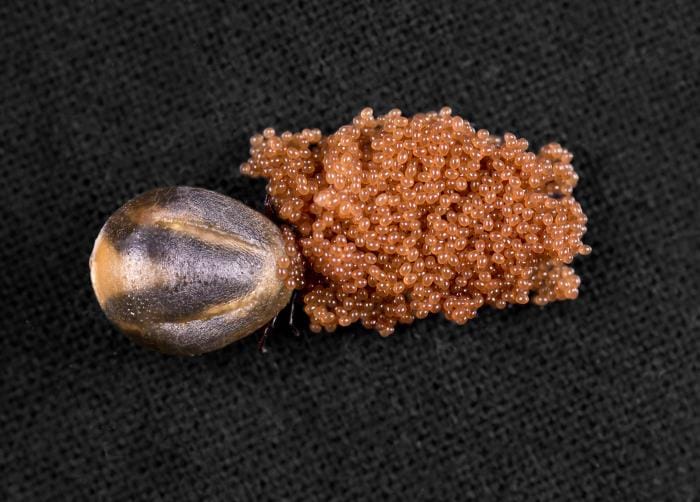
Tick eggs are tiny, round to oval and laid in a dense batch. Depending on species and age, they can appear amber, reddish-brown, tan or darker as development progresses.
A fed adult blacklegged tick can become dramatically enlarged before egg laying. CDC’s Public Health Image Library notes that an adult female Ixodes scapularis can lay approximately 2,000–4,000 eggs.
The female does not care for the eggs after laying them. The eggs remain in a protected microhabitat until hatching conditions are suitable.
Where Do Ticks Lay Their Eggs?
Eggs are generally deposited where humidity and shelter improve survival, often in leaf litter, soil-level debris, cracks, protected ground cover or other sheltered sites.
For outdoor species, that does not mean a homeowner should expect to find neat egg balls sitting visibly in the middle of the lawn. The same humid, shaded habitat that protects ticks also makes egg masses hard to notice.
Brown dog ticks are different because females can lay eggs in protected indoor crevices when an infestation becomes established in a home or kennel.
Leaf litter, shaded ground and protected debris can shelter eggs and immature ticks.
Ivy, invasive shrubs and other dense vegetation can create the humid microclimate ticks need.
Brown dog ticks may use cracks and protected areas around kennels or homes.
Hot, dry, exposed areas are generally less favorable for tick survival than humid shaded edges.
Why Hundreds of Tiny Ticks Can Look Like a ‘Nest’
After eggs hatch, the larval stage has six legs and is extremely small. Large groups may emerge in the same general area, which is why a person can suddenly find many tiny ticks on shoes or lower legs.
These larvae are often called seed ticks. The term describes the tiny larval stage; it is not a separate tick species.
Clusters are especially memorable with lone star ticks because their larvae can aggressively contact people and animals in large numbers.
Are Larval Ticks Dangerous?
Disease risk depends on tick species, life stage and pathogen. The answer should not be simplified into ‘larvae are harmless’ or ‘every larva is infected.’
Blacklegged ticks often acquire Borrelia burgdorferi, the bacterium that causes Lyme disease, during feeding as larvae or nymphs. That is one reason nymphs, not newly hatched larvae, are especially important in Lyme transmission.
Lone star tick larvae do not transmit Lyme disease, but lone star ticks are medically important for other reasons. Species identification matters.
What to Do If You Find an Egg Mass or Cluster of Tiny Ticks
Do not handle an unknown cluster with bare hands. Take a clear photo, avoid spreading it through the house, and inspect people and pets who were in the area.
If tiny ticks are crawling on skin or clothing, remove them promptly, shower, check the entire body and follow CDC clothing guidance. If a tick is attached, remove it with fine-tipped tweezers.
If you repeatedly encounter larvae in one yard zone, look at habitat: leaf litter, brush, wildlife movement, groundcover and other protected areas can all contribute.
Get a close, well-lit image before disturbing the cluster if identification may be useful.
Move people and pets away from the immediate area and check clothing, socks, shoes and skin.
Use appropriate washing/drying procedures after exposure.
Reduce leaf accumulation, dense groundcover and other protected tick habitat near family-use areas.
Three ‘Tick Nest’ Claims to Be Skeptical About
Online photos frequently label unrelated insect eggs, spider egg sacs, plant material or mold as tick nests. A dramatic image is not evidence of tick identification.
Another myth is that destroying one egg mass will make a yard tick-free. It can remove that one batch, but ticks are continually moved through landscapes by wildlife and pets.
The practical goal is habitat management, routine tick checks and targeted control, not a treasure hunt for every egg mass.
The word ‘nest’ makes it sound like there is a little tick headquarters somewhere in the yard. That’s not really how it works. I would rather have a family understand the habitat that keeps ticks alive than spend the weekend trying to find one scary-looking clump of eggs.
Trusted Sources & Further Reading
The factual foundation for this guide includes the following public-health, university and peer-reviewed resources.
- CDC PHIL : Female blacklegged tick laying eggs: CDC notes roughly 2,000–4,000 eggs for an adult female blacklegged tick.
- CDC : Tick Lifecycles: Egg, larva, nymph and adult life stages.
- CDC : About Ticks and Tickborne Disease: Host seeking and disease-transmission basics.
- Rutgers NJ Ticks 4 Science : FAQ: New Jersey tick habitat and prevention context.
Frequently Asked Questions
Do ticks make nests?
No. Ticks do not build organized nests. The phrase usually refers to an egg mass, a cluster of larvae or a place with heavy tick activity.
How many eggs can a tick lay?
It varies by species. CDC PHIL notes that a fed adult female blacklegged tick can lay approximately 2,000–4,000 eggs.
What color are tick eggs?
Tick eggs are very small and can appear tan, amber, reddish-brown or darker depending on species and development. Identification from color alone is unreliable.
What are seed ticks?
Seed ticks are larval ticks. They are extremely small, have six legs and may be encountered in groups after hatching.
Can tick eggs hatch inside a house?
Most outdoor tick species are not adapted to establish household infestations, but brown dog ticks can reproduce indoors in homes or kennels.
Should I spray a suspected tick nest?
Do not treat an unidentified cluster blindly. Identify what you are seeing first, then address real tick habitat and exposure using appropriate methods.
Think Habitat, Not 'Nests'
Bite Back provides targeted, all-natural tick and mosquito control for New Jersey yards. Our service focuses on the shaded edges, landscaping, fence lines, wooded borders and other areas where pest pressure develops.
No yard can be made completely tick- or mosquito-free, but habitat reduction, smart prevention and consistent seasonal treatment can make a meaningful difference.
Choose Bite Back, because what is sprayed in your yard matters.
The Weekly Bite
Get 5 fresh yard-defense reads every Wednesday
Tick and mosquito intel for North Jersey yards. No spam, unsubscribe anytime.