How Long Does a Tick Need to Be Attached to Transmit Disease? It Depends on the Pathogen
You may have heard that a tick must be attached for 24, 36 or 48 hours before there is any risk. That rule is too simple. Transmission timing depends on the tick species, pathogen and biology of the infection.

The Weekly Bite
Get 5 fresh yard-defense reads every Wednesday
Tick and mosquito intel for North Jersey yards. No spam, unsubscribe anytime.
Quick Guide — tap to open
The Quick Answer: There Is No Universal ‘Safe’ Number of Hours
For Lyme disease, the probability of transmission generally increases the longer an infected blacklegged tick remains attached and feeding. Public-health guidance emphasizes that prompt removal lowers risk.
But Lyme is not the only pathogen transmitted by blacklegged ticks, and other tickborne agents have different transmission biology.
That means ‘it was attached less than 24 hours, so nothing can happen’ is not a safe statement for every tickborne disease.
Lyme Disease: Risk Rises With Prolonged Attachment
Borrelia burgdorferi, the bacterium that causes Lyme disease in the eastern United States, resides in the tick and undergoes changes during feeding before efficient transmission.
CDC patient guidance has long emphasized that infected blacklegged ticks generally need to be attached for more than 24 hours for Lyme transmission to become likely, and prompt removal reduces risk.
That is a population-level biological principle—not a stopwatch guarantee that every bite under a particular hour mark is zero risk.
Babesiosis: A Different Organism, Also Linked to Feeding Time
Babesiosis in the Northeast is usually caused by Babesia microti and transmitted by blacklegged ticks.
CDC notes that nymphs usually must remain attached for more than 36–48 hours to transmit B. microti in experimental work and public-health guidance.
Again, the practical lesson is the same: remove attached ticks as soon as they are found.
Powassan Virus: Why the ’24-Hour Rule’ Cannot Be Applied to Everything
Powassan virus is far less common than Lyme disease but potentially serious. Experimental studies show that infected ticks can transmit Powassan virus much faster than the typical Lyme timeline.
CDC describes Powassan as transmitted to people by infected ticks, especially blacklegged ticks in the Northeast and Great Lakes regions.
The existence of a faster-transmitting pathogen is one reason clinicians and public-health agencies do not recommend treating attachment duration as the only factor after a tick bite.
Why It Is Hard to Know Exactly How Long a Tick Was Attached
A person often notices a tick after showering, changing clothes or feeling a bump. The exact moment of attachment is rarely observed.
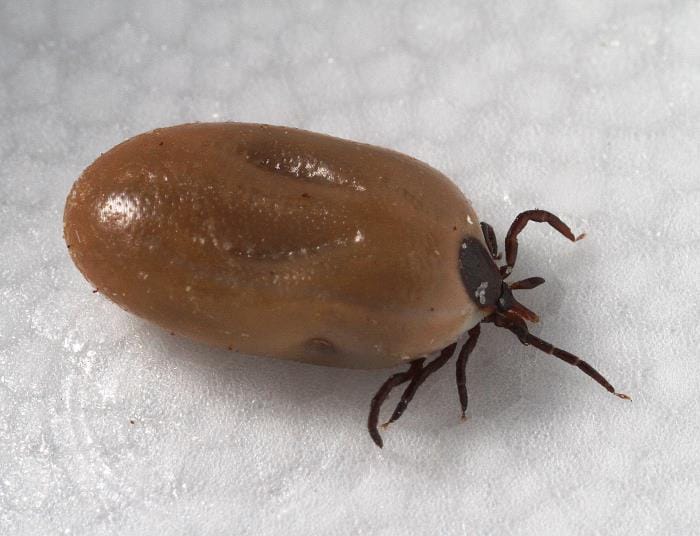
Degree of engorgement can provide clues: a flat tick likely fed for less time than a visibly swollen one. But visual estimates are imperfect, especially for tiny nymphs.
Species identification, life stage, engorgement, geographic exposure and symptoms all provide context.
Suggests limited feeding, but exact time cannot be read like a clock.
Indicates feeding has occurred and deserves careful assessment.
Consistent with prolonged feeding and potentially greater transmission opportunity for some pathogens.
Save or photograph the tick if practical; species changes which diseases are relevant.
What to Do Instead of Obsessing Over the Clock
Remove the tick promptly and correctly. CDC recommends fine-tipped tweezers, grasping close to the skin and pulling upward with steady, even pressure.
Record the date and likely location of exposure. Consider saving a photo or specimen for identification.
Watch for symptoms and contact a healthcare professional when appropriate. Medical decisions after a blacklegged-tick bite can depend on factors including species, estimated attachment duration, local Lyme epidemiology and timing—not one internet rule.
Do not wait for a tick to detach on its own.
Species and life stage help define which pathogens are relevant.
Note whether the tick is flat or engorged, but do not treat this as exact timing.
Record date and location of exposure.
Especially for symptoms, high-risk exposures, pregnancy, immune compromise or questions about Lyme prophylaxis.
The Best Attachment Time Is No Attachment Time
Daily tick checks after outdoor exposure can find crawling or recently attached ticks sooner. Showering soon after coming indoors can also help locate ticks before they have fed for long.
Yard habitat reduction and pet prevention reduce the number of encounters that occur in the first place.
Prompt detection is valuable across pathogens even though the transmission timelines are not identical.
I understand why everyone wants one number—24 hours, 36 hours, something simple. But different diseases do not use the same clock. The part we can control is finding and removing the tick as soon as possible, saving the details and getting medical advice when the situation calls for it.
Trusted Sources & Further Reading
The factual foundation for this guide includes the following public-health, university and peer-reviewed resources.
- CDC — Lyme Disease: Causes and How It Spreads — Lyme transmission and attachment-duration context.
- CDC — Preventing Babesiosis — CDC states I. scapularis nymphs usually must remain attached more than 36–48 hours to transmit B. microti.
- CDC — About Powassan — Powassan virus transmission and geography.
- CDC Stacks — Pathogen transmission during tick feeding review — Review of attachment-time evidence across tickborne pathogens.
- CDC — What to Do After a Tick Bite — Correct tick removal and symptom guidance.
Frequently Asked Questions
Can Lyme disease transmit in less than 24 hours?
Lyme transmission generally becomes more likely with prolonged attachment, and public-health guidance emphasizes that prompt removal lowers risk. No hour cutoff should be treated as an absolute guarantee.
Does every tickborne disease require 24 hours of attachment?
No. Different pathogens have different transmission biology. Powassan virus, for example, can transmit much more rapidly in experimental studies.
How long does a tick need to be attached for babesiosis?
CDC notes that blacklegged-tick nymphs usually need prolonged attachment—often more than 36–48 hours—to transmit Babesia microti.
Can I tell attachment time by how swollen the tick is?
Engorgement provides a rough clue but not an exact clock. Species, stage and feeding conditions affect appearance.
Should I wait to remove a tick until I can identify it?
No. Remove it promptly. You can photograph or save the tick after removal for identification.
When should I call a doctor after a tick bite?
Seek medical advice for concerning symptoms or if you have questions about a high-risk exposure. A clinician can consider species, geography, attachment, timing and your health history.
Reduce Tick Encounters Before the Clock Ever Starts
Bite Back provides targeted, all-natural tick and mosquito control for New Jersey yards. Our service focuses on the shaded edges, landscaping, fence lines, wooded borders and other areas where pest pressure develops.
No yard can be made completely tick- or mosquito-free, but habitat reduction, smart prevention and consistent seasonal treatment can make a meaningful difference.
Choose Bite Back, because what is sprayed in your yard matters. 🌿
This article is educational and is not medical advice. Tickborne-disease risk and treatment decisions require individual clinical assessment.
The Weekly Bite
Get 5 fresh yard-defense reads every Wednesday
Tick and mosquito intel for North Jersey yards. No spam, unsubscribe anytime.