Common Ticks Found in New Jersey (and How to Spot Them)
Ticks are a growing problem across New Jersey, especially in spring and summer. From Monmouth, Middlesex, and Mercer to Ocean and surrounding counties, our goal is to help you quickly identify local tick species, understand the diseases they can carry, and protect your family using all-natural tick control.
Ticks are tiny arachnids (related to spiders and mites) that thrive in New Jersey’s woods, fields, brush lines, and even well-kept backyards. A single bite can transmit serious illnesses like Lyme disease, anaplasmosis, babesiosis, ehrlichiosis, and in rare cases even more severe infections. Because nymph-stage ticks are often no bigger than a poppy seed, many people never realize they’ve been bitten until symptoms appear—or until they find a tick after it has already fed.
The Weekly Bite
Get 5 fresh yard-defense reads every Wednesday
Tick and mosquito intel for North Jersey yards. No spam, unsubscribe anytime.
Knowing how to identify the main tick species found in NJ is the first step in protecting your family, pets, and yard. The next step is combining smart personal protection with a consistent prevention routine—especially in the places ticks actually live: wooded edges, shaded landscaping, leaf litter, and the “perimeter zones” that pets use every day.
This section is designed to be a one-stop reference you can come back to throughout the season. It includes a quick identification table, visual ID cards for the four medically important ticks most homeowners hear about in New Jersey, and a research-style explanation of where ticks hide, how they find hosts, and what actually reduces exposure on real NJ properties.
Quick ID: NJ Ticks at a Glance
If you only read one part, read this table. Most homeowners don’t need to memorize Latin names—they need a fast “what am I looking at?” checklist that maps the tick to the right next steps. Use this chart as your first pass, then scroll down to each tick card for more details. If you’re unsure, take a clear photo (good lighting, close-up) and keep the tick in a sealed bag or container.
| Tick | Quick look | Where you’ll see it | Why people care |
|---|---|---|---|
| Blacklegged (Deer) Tick | Small; nymphs are poppy-seed sized; adults sesame-seed sized; female often has reddish abdomen | Wooded edges, leaf litter, shaded shrubs, trail borders | Most associated with Lyme disease risk in NJ |
| American Dog Tick | Larger; patterned/ornate look; easier to spot | Grassy edges, paths, fields, trail margins | Associated with RMSF + tularemia discussions |
| Lone Star Tick | Female often has a single white dot; can feel “aggressive” | Brushy edges, wooded transition zones | Associated with ehrlichiosis; alpha-gal discussions |
| Brown Dog Tick | Reddish-brown; can appear repeatedly on dogs; can infest indoor/kennel spaces | Dogs, dog runs, kennels; sometimes indoors | Dog-focused tick; repeated ticks can signal a home/kennel cycle |
Reality check: Most “tick problems” are not evenly spread across the whole lawn. They’re concentrated in predictable zones—edges, shade, and leaf litter. That’s why targeted prevention beats blanket spraying.
Where Ticks Hide in New Jersey Yards (Even “Nice” Ones)
Ticks survive best in areas that stay cool, shaded, and humid. In New Jersey, those conditions show up in a lot of places homeowners don’t think about: under shrubs, along fence lines where brush grows up, behind sheds, in groundcover beds, and especially in leaf litter at the edge where lawn meets woods. This is why a property can look perfectly maintained and still produce ticks. The center lawn might be sunny and dry, but the perimeter is a different ecosystem.
Here’s a simple way to visualize it: your yard has living zones (patio, grill, play areas) and edge zones (woodline, brush line, shaded beds). Most tick encounters start in the edge zone and then get carried into the living zone—on shoes, socks, dogs, or clothing. So the goal is not to “kill every tick in nature.” The goal is to make the edge less tick-friendly and keep daily life out of that edge.
Common high-pressure microhabitats in NJ
If you want to find your hot spots fast, start here. Walk the perimeter of your home and mark these areas:
- Leaf litter under shrubs, hedges, and trees (humidity + shelter).
- Brushy fence lines where grass transitions into unmanaged growth.
- Groundcover beds that never fully dry (ticks + rodents love these).
- Under-deck pockets (cool, shaded, low-airflow zones).
- Wood piles / stone borders (also attract mice and chipmunks).
- Pet routes where dogs push into shrubs daily (repeated exposure path).
The “edge rule”: If you fix the edges, most properties feel dramatically different. If you ignore the edges, even the best service plan struggles.
How Ticks Bite (Questing + Attachment) and Why You Don’t Notice
Most people picture ticks “jumping” or “falling” from trees. The more common behavior is questing—ticks position themselves on vegetation and wait for a host. When a person or pet brushes by, the tick grabs on and crawls to a feeding site. Because tick saliva can reduce pain and irritation, bites often go unnoticed. This is why prevention is built around reducing contact and catching ticks early.
Nymphs are particularly challenging because of their size. If your goal is “never get bitten,” you’ll fail—because nymphs can be nearly invisible. A better goal is: (1) reduce how often ticks reach your family, and (2) reduce how long a tick stays attached by building consistent check routines.
Where to check first (fast, realistic routine)
Tick checks don’t have to be a 20-minute event. Start with high-probability areas: ankles/socks, behind knees, waistline, underarms, collar line, hairline/scalp, and for pets—ears, neck, belly, and between toes. Build it into habits: after dog walks, after sports, after yard work, after hiking.
Seasonality: When Tick Risk Is Highest in New Jersey
New Jersey tick exposure is not “one season.” Different life stages are active at different times, and risk changes with temperature and humidity. In general, nymph activity overlaps with late spring and summer routines (when families are outside most), while adult ticks are commonly encountered in cooler months, including fall and early spring. The practical implication is: the highest-risk times are when tick activity and human outdoor behavior overlap.
Also: winter isn’t automatically “tick-free.” On milder winter days above freezing, adult blacklegged ticks can still quest. That doesn’t mean panic—just avoid brushy edges and keep checks in place when you’re doing winter hikes, yard cleanups, or dog walks along wooded borders.
Common Ticks Found in New Jersey (& How to Spot Them)
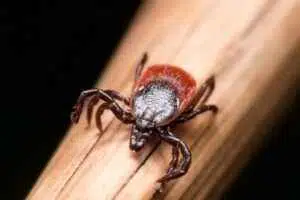
Blacklegged Tick (Deer Tick) • Ixodes scapularis
The blacklegged tick is the tick most associated with Lyme disease in New Jersey and can also be linked to anaplasmosis, babesiosis, and Powassan virus. Adults are about the size of a sesame seed. Females often show a dark head/legs with a reddish-orange abdomen. Nymphs can be poppy-seed sized and are easy to miss.
Where it hides in NJ
Leaf litter, wooded borders, shaded shrub lines, and trail edges. If your yard backs to woods, or you have deep landscaping beds that stay damp, blacklegged ticks are the species most homeowners think of first.
Why it’s important
Lyme risk is driven by exposure + time (how long a tick feeds) + missed detection. Because nymphs are small and active during heavy outdoor months, people often focus prevention on the late spring–summer overlap.
Learn more: Blacklegged / Deer Tick in NJ
American Dog Tick • Dermacentor variabilis
The American dog tick is commonly found in grassy, open areas and along trails. It’s associated with Rocky Mountain spotted fever and tularemia discussions. Adults are larger than deer ticks and can show distinct white/tan markings on the back.
Where it hides in NJ
Field edges, tall grasses, trail margins, and open brushy areas. If you walk dogs near parks, athletic fields with tall perimeter grass, or trails with edge vegetation, this species can be a common encounter.
What homeowners should do
Keep play zones and frequent walk routes out of tall perimeter grass. If your property has “wild” grass at the edge, treat it like a tick zone: trim it, keep a buffer, and run quick checks after exposure.
Learn more: American Dog Tick in NJ

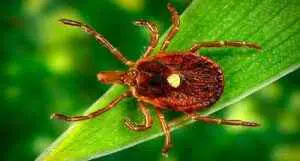
Lone Star Tick • Amblyomma americanum
The lone star tick is expanding into more parts of New Jersey. It can be associated with ehrlichiosis and has been linked to alpha-gal syndrome (red meat allergy) in some cases. Adult females are often identified by a single white “lone star” spot.
Why it feels “different”
Some homeowners describe lone star ticks as more aggressive. Whether you experience that or not, the prevention strategy is the same: avoid brushy edges, keep vegetation controlled, and keep dogs from diving into perimeter shrubs.
High-risk yards for lone star ticks
Properties near wooded transition zones, brushy fields, and trail systems. If your yard has thick edge vegetation that stays humid, it can support multiple tick species—including lone star ticks.
Learn more: Lone Star Tick in NJ
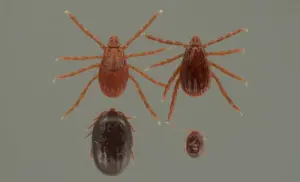
Brown Dog Tick • Rhipicephalus sanguineus
The brown dog tick is most often found on dogs and can live indoors, in kennels, or around dog runs. Adults are reddish-brown and can be about the size of a watermelon seed. If you find ticks repeatedly on a dog (especially if you also see them in the home/kennel environment), this species is a major suspect.
Why this one matters to pet owners
Brown dog tick situations often feel like “they keep coming back.” That’s because the environment (dog run, kennel, or sometimes the home) can become part of the cycle. Pet prevention + environmental cleanup + professional guidance is usually the best approach.
What to do if you suspect brown dog tick
Talk with your veterinarian about an appropriate prevention plan, vacuum regularly in pet areas, wash bedding, and address kennel/dog-run cracks and corners. If ticks are appearing indoors, treat it as an infestation problem, not just a “yard problem.”
Learn more: Brown Dog Tick in NJ
What to Do If You Find a Tick on You or Your Pet
The best response to finding a tick is calm and procedural. The main goals are: (1) remove it safely, (2) clean the area, (3) note the date and likely exposure location, and (4) monitor for symptoms. If symptoms develop—fever, rash, unusual fatigue, headache, or joint pain—contact a healthcare provider. For pets, contact a veterinarian if your dog or cat becomes lethargic, limps, has fever, or seems “off.”
Simple removal: Use fine-tipped tweezers, grab the tick close to the skin, and pull upward with steady pressure (don’t twist). Clean the bite area afterward. If you’d like, keep the tick in a sealed bag/container and label it with the date.
Why speed matters
Many tick-borne pathogens are transmitted during feeding. In general, risk increases the longer a tick remains attached. That’s why a “same-day tick check” after outdoor time is one of the most powerful prevention tools families have.
Where bites happen most often
On people: ankles/socks, behind knees, waistline, underarms, and scalp/hairline. On dogs: ears, collar line, chest, belly, armpits, between toes. Build a quick routine that targets these first, then expand if you’ve been in heavy brush or leaf litter.
The most reliable tick plan in New Jersey is a 3-layer approach: personal protection, pet protection, and yard protection. Each layer reduces risk in a different way, and when combined they dramatically reduce the odds of a tick feeding long enough to cause problems. Most families don’t fail because they “did nothing”—they fail because they only used one layer (or they treated the wrong parts of the yard).
Layer 1: Personal protection (quick wins)
- Repellent strategy: Use repellent as directed—especially on socks, shoes, and lower legs for yard work and trails.
- Clothing strategy: Light colors help you spot ticks. Tuck pants into socks when working in brushy areas.
- Routine strategy: Tick checks after outdoor time are the most repeatable “risk reducer” for families.
Layer 2: Pet protection (because pets amplify exposure)
- Vet-approved preventatives: Ask your veterinarian what fits your pet’s age, health, and lifestyle.
- Post-walk checks: Ears, collar line, belly, legs, paws, and between toes.
- Behavior change: Keep dogs from pushing into the perimeter shrub line—this is where ticks wait.
Layer 3: Yard protection (where NJ homeowners see the biggest results)
- Clean up tick habitat: Remove leaf litter, trim brush along fence lines, and keep the perimeter open to sun/airflow.
- Create buffers: A dry barrier (wood chips/gravel) between lawn and woods helps reduce tick movement into living spaces.
- Move living zones: Keep playsets, seating, and dog resting zones away from wooded edges and dense landscaping.
- Target mice & wildlife corridors: Reduce clutter where rodents travel; consider tick tubes where appropriate.
- Professional all-natural tick control: Bite Back Tick & Mosquito Control uses EPA Section 25(b) minimum-risk, plant-based formulas to treat brush lines, shaded turf, and high-risk zones around your home.
The difference between a “good” plan and a “great” plan is targeting. Ticks don’t live in the middle of a sunny lawn the way people imagine. They live in edges, shade, leaf litter, and the daily routes wildlife and pets use. When your plan treats those zones (and maintains them weekly), your yard becomes less tick-friendly and outdoor time gets easier.
FAQ: NJ Tick Identification & Prevention
Do I need to know the exact tick species?
It helps, but you don’t need to be perfect. If you’re unsure, focus on the essentials:
remove the tick safely, document the date, and monitor symptoms. Species ID is most helpful for understanding risk and improving prevention.
Why do we still get ticks in a well-kept yard?
Because ticks live in microhabitats: shaded edges, leaf litter, and dense beds. The yard can look great, while the border zones still provide humidity and shelter.
Cleaning and maintaining the perimeter is usually the most important fix.
Are ticks only a spring/summer issue in NJ?
Spring and summer are high exposure months because people spend more time outside and nymphs are active, but adults can be active in cooler months too.
Treat mild winter days like “shoulder season” tick days—avoid brushy edges and do quick checks.
What’s the fastest way to reduce exposure for kids?
Keep play areas away from edges, reduce leaf litter/brush at the perimeter, and build a simple tick-check routine after outdoor time.
The combination is more powerful than any single tactic.
What’s the biggest pet-owner mistake?
Letting dogs run the perimeter shrub line every day without post-walk checks. Dogs are excellent “tick transport,” and the perimeter is where ticks wait.
Behavior + prevention + yard edge control is the winning combination.
The Weekly Bite
Get 5 fresh yard-defense reads every Wednesday
Tick and mosquito intel for North Jersey yards. No spam, unsubscribe anytime.